

Drawn arc welding with ceramic ferrule is the variant of drawn arc welding for large studs and longer welding times. A ceramic ferrule protects the weld pool. Here you can find out when you need it, how it works and how the process runs.
In short
With a stud diameter of more than 5 mm and longer welding times, the weld pool becomes large and turbulent, so a ceramic ferrule protects the weld spot. It stabilises the arc, forms the melt and shields it from the atmosphere. After welding, it is simply broken off. As no gas cylinders are needed, the process is very well suited to construction sites.
On this page
- When do you need a ceramic ferrule?
- How does the ceramic ferrule work?
- What is the ceramic ferrule made of?
- Why is the process suitable for construction sites?
- How does the process with ceramic ferrule work?
- What is the aluminium ball in the stud for?
- What technical data apply?
- What does drawn arc welding with ceramic ferrule look like in practice?
When do you need a ceramic ferrule?
Because welds with a diameter > 5 mm and increasing welding times produce an increasingly large and turbulent weld pool, a ceramic ferrule must be used to protect the weld pool.
How does the ceramic ferrule work?
The ceramic ferrule supports the welding process by stabilising and confining the arc, forming the melt and shielding it from the atmosphere. The shielding also makes the weld spot cool down more slowly, which has a positive effect on the weld structure.
What is the ceramic ferrule made of?
The ceramic ferrule is pushed over the stud before welding and removed by breaking it off after solidification. Its main components are magnesium aluminium silicate and aluminium oxides, and it is characterised by high temperature and thermal shock resistance. As your system supplier, we choose the right ceramic ferrule for you, so you always receive the right combination of ceramic ferrule and stud.
Why is the process suitable for construction sites?
The ceramic ferrule is very well suited to construction sites, because welding can usually be done with lightweight stud welding equipment and no heavy, unwieldy gas cylinders get in the way. It also prevents arc blow caused by environmental influences, for example wind.
How does the process with ceramic ferrule work?
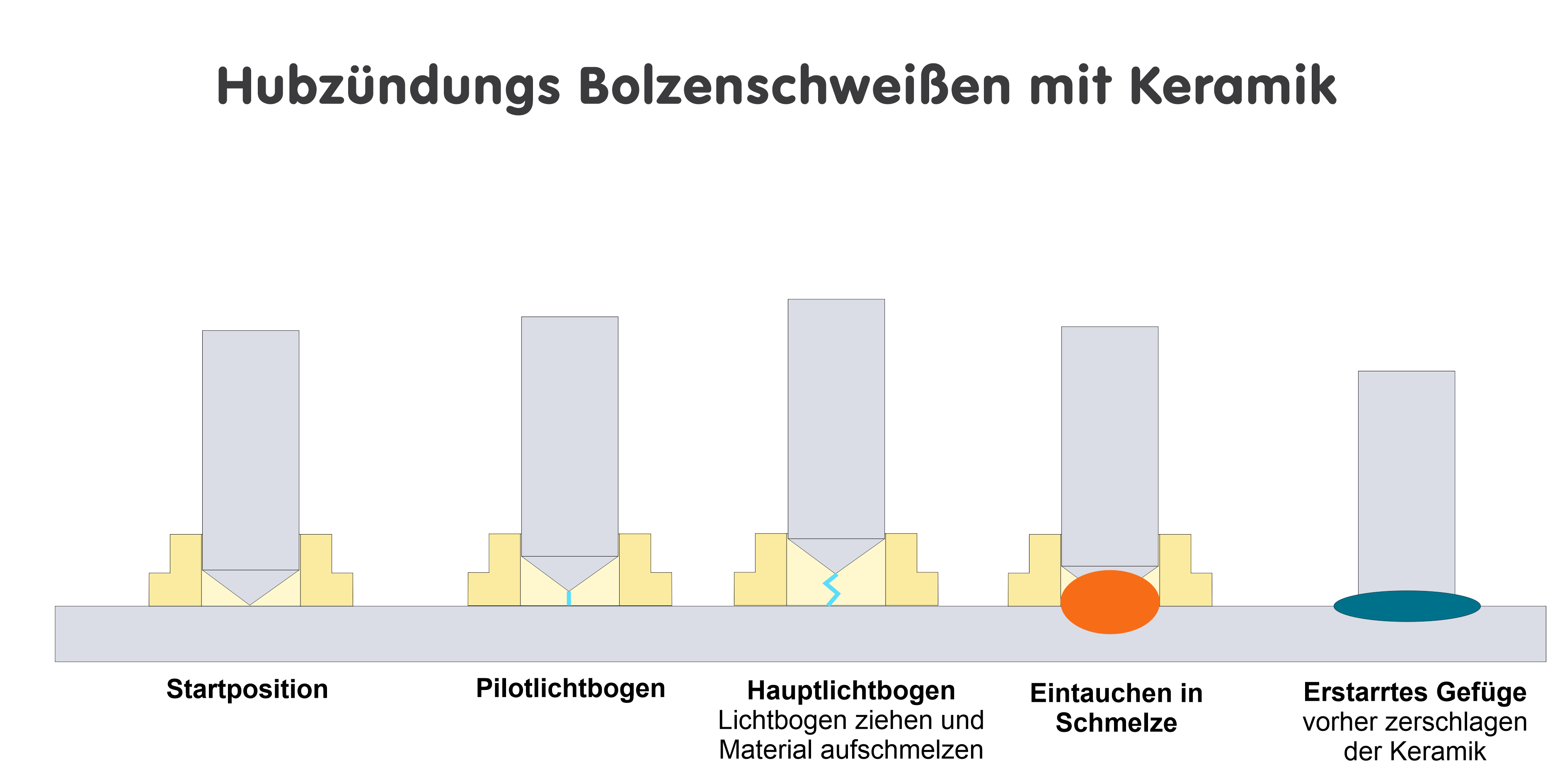
First, the ceramic ferrule is fitted onto the ferrule holder directly at the stud. Both are then placed on the workpiece together. To start the process, the stud is first lifted from the workpiece with low current and a pilot arc. After a short "holding time", the main arc is ignited, which really melts the materials. The ceramic ferrule confines it and prevents arc blow and dripping.
During the entire welding process, the stud is lifted from the workpiece for the set welding time and then plunged back into the molten pool of the workpiece. This joins the stud to the workpiece. Finally, the ceramic ferrule is broken off with very little force, leaving the firmly welded stud.
The graphic above shows the sequence in five steps:
- Starting position: Stud and ceramic ferrule rest on the workpiece.
- Pilot arc: The stud is lifted and an arc with low current forms.
- Main arc: The arc is drawn and melts the material.
- Plunging into the molten pool: The stud plunges into the molten pool.
- Solidified structure: The melt solidifies, then the ceramic ferrule is broken off.
What is the aluminium ball in the stud for?
In welding with ceramic ferrule, an aluminium ball incorporated into the tip of the stud has become established.
It mainly makes it easier to ignite the pilot arc and calms and deoxidises the weld pool. The aluminium also increases the fine-grained structure in the weld zone and prevents porosity.
Under no circumstances are these studs used in the short-cycle process or in shielding gas welding, as faulty melting can, in the worst case, lead to brittle fractures in the fusion zone.
What technical data apply?
| Parameter | Value |
|---|---|
| Stud diameter d (mm) | 5-25 |
| Peak current approx. (A) | 300-3000 |
| Welding time approx. (ms) | 100-2000 |
| Min. workpiece thickness | 1/4 d (stud) |
| Surface | Bare metal, flash rust, mill scale (rougher surfaces) |
| Ceramic ferrule required | yes |
| Shielding gas function required | no |
You can find all parameters compared with the short-cycle process and shielding gas on the drawn arc page. Values may vary depending on unit and application.
What does drawn arc welding with ceramic ferrule look like in practice?
Would you like to know whether drawn arc welding with ceramic ferrule suits your component?
We will be happy to advise you personally, by phone on +49 2302 95640-0 or by message.
More topics
Scope, variants and key data at a glance.
Short welding time, easy to automate.
For very high-quality, visually appealing welds.
Causes of one-sided weld collars and how to avoid them.
