

Drawn arc welding with shielding gas is a variant of drawn arc welding in which a gas protects the molten pool. It is mostly used as an alternative to welding with a ceramic ferrule. Here you can find out how the process works, which gases are used and what the sequence looks like.
In short
In drawn arc welding with shielding gas, a gas shields the melt from the atmosphere instead of a ceramic ferrule. This prevents the absorption of nitrogen, reduces oxidation and avoids porosity. The process is mostly used for stud diameters up to 12 mm and produces high-quality, visually appealing welds.
On this page
- When is drawn arc welding with shielding gas used?
- How does the shielding gas work?
- Which shielding gases and gas volumes are used?
- How do you achieve good results with shielding gas?
- How does the process with shielding gas work?
- What technical data apply?
- What does drawn arc welding with shielding gas look like in practice?
When is drawn arc welding with shielding gas used?
Shielding gas welding is mostly used as an alternative to ceramic ferrule welding for stud diameters up to 12 mm. Overall, stud welding with shielding gas produces high-quality, visually appealing welds.
How does the shielding gas work?
The shielding gas shields the melt from the atmosphere and thus prevents the absorption of nitrogen, reduces oxidation and avoids porosity. The shielding gas also influences the melting behaviour, resulting in shallower penetration and more melting at the stud compared with welds using a ceramic ferrule.
Which shielding gases and gas volumes are used?
Depending on the application, ArCO2 82/18, Ar, He and mixtures of these are used. The required gas volume is approximately 10 to 20 l/min, depending on stud size and welding time. We will be happy to discuss which gas suits your application in a consultation.
How do you achieve good results with shielding gas?
With our long-proven shielding gas technology, you can achieve very good welding results with Arnhold stud welders. Above all, the right earth connection is important to avoid arc blow, because shielding gas welding is more sensitive to arc blow at workpiece edges and with asymmetrical earth points. We will be happy to advise you based on our many years of experience.
How does the process with shielding gas work?
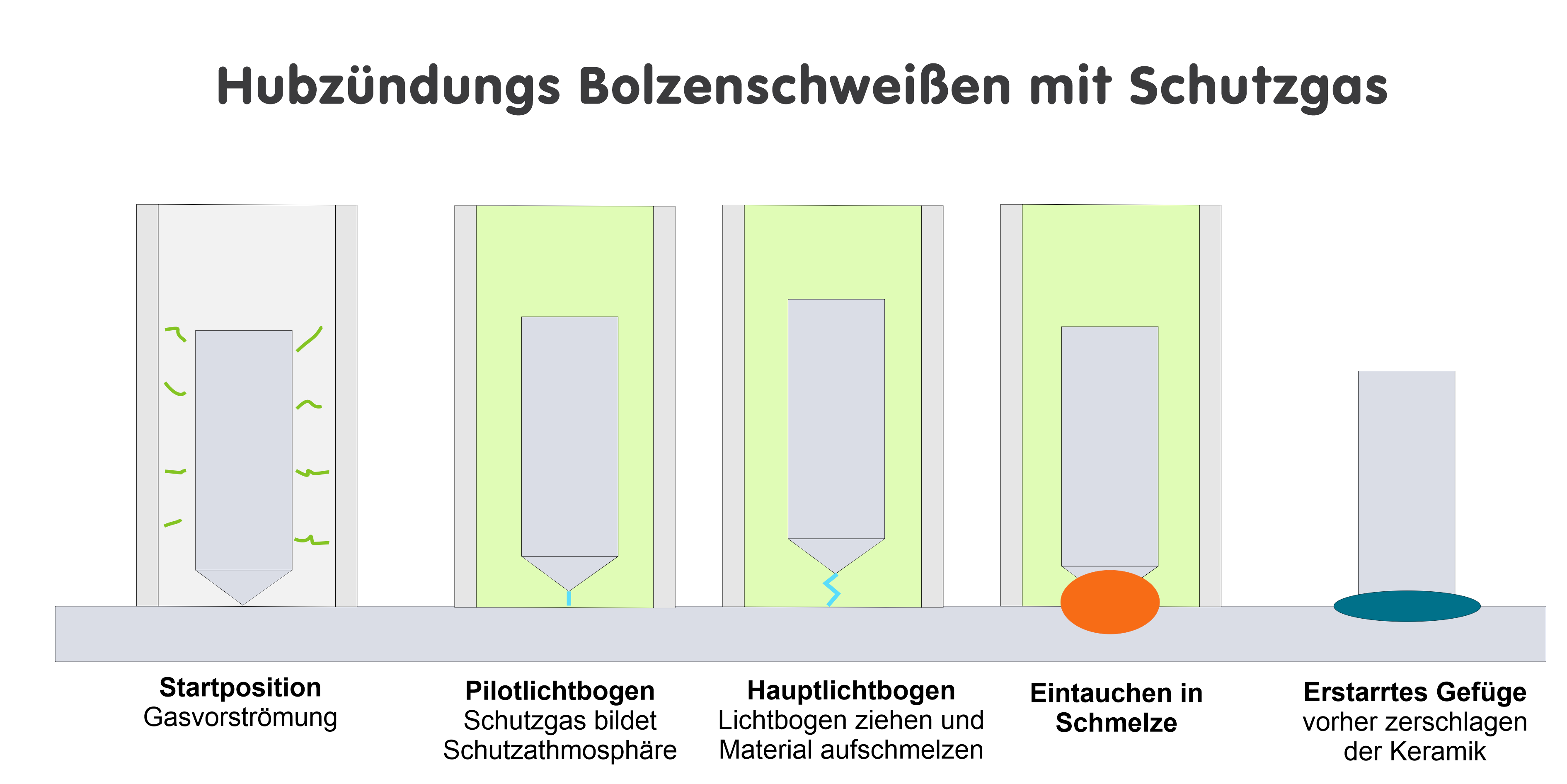
At the start, the stud rests on the workpiece and is lifted from it. This is also when the shielding gas pre-flow takes place, and a pilot arc is first created with low current. After a short "holding time", the main arc is ignited, which really melts the materials. The shielding gas forms the protective atmosphere. Optimised shielding gas devices, such as the AS 2901 or AS 2902, ensure reduced arc blow thanks to an even gas flow.
During the entire welding process, the stud is lifted from the workpiece for the set welding time and, once this has elapsed, plunged into the molten pool of the workpiece. This joins the stud to the workpiece. The finished weld is ready as soon as the device is lifted off.
The graphic above shows the sequence in five steps:
- Starting position: The stud rests on the workpiece and the shielding gas pre-flows.
- Pilot arc: The stud is lifted and the shielding gas forms the protective atmosphere.
- Main arc: The arc is drawn and melts the material.
- Plunging into the molten pool: The stud plunges into the molten pool.
- Solidified structure: The melt solidifies and the joint is complete.
What technical data apply?
| Parameter | Value |
|---|---|
| Stud diameter d (mm) | up to 12 |
| Peak current approx. (A) | 300-3000 |
| Welding time approx. (ms) | 5-2000 |
| Min. workpiece thickness | 1/8 d (stud) |
| Surface | Bare metal, galvanised (suitable for poorer surfaces) |
| Shielding gases | ArCO2 82/18, Ar, He and mixtures |
| Gas volume approx. (l/min) | 10-20 |
| Ceramic ferrule required | no |
You can find all parameters compared with the short-cycle process and ceramic ferrule on the drawn arc page. Values may vary depending on unit and application.
What does drawn arc welding with shielding gas look like in practice?
This video shows drawn arc welding with the short-cycle process and with shielding gas:
Would you like to know whether drawn arc welding with shielding gas suits your component?
We will be happy to advise you personally, by phone on +49 2302 95640-0 or by message.
More topics
Scope, variants and key data at a glance.
Short welding time, easy to automate.
For large studs and longer welding times.
Causes of one-sided weld collars and how to avoid them.
