

Studs can be attached to almost all weldable metals. Which process is suitable depends on the material and its surface. Here you will find answers to the most common questions about materials.
In short
Steel, stainless steel, aluminium and brass can all be stud welded well, each with the right process. On galvanised sheet the result depends on the zinc layer, and painted surfaces must be bare at the weld spot. Free-cutting steels with a high sulphur or lead content are unsuitable.
On this page
What materials are weld studs made of?
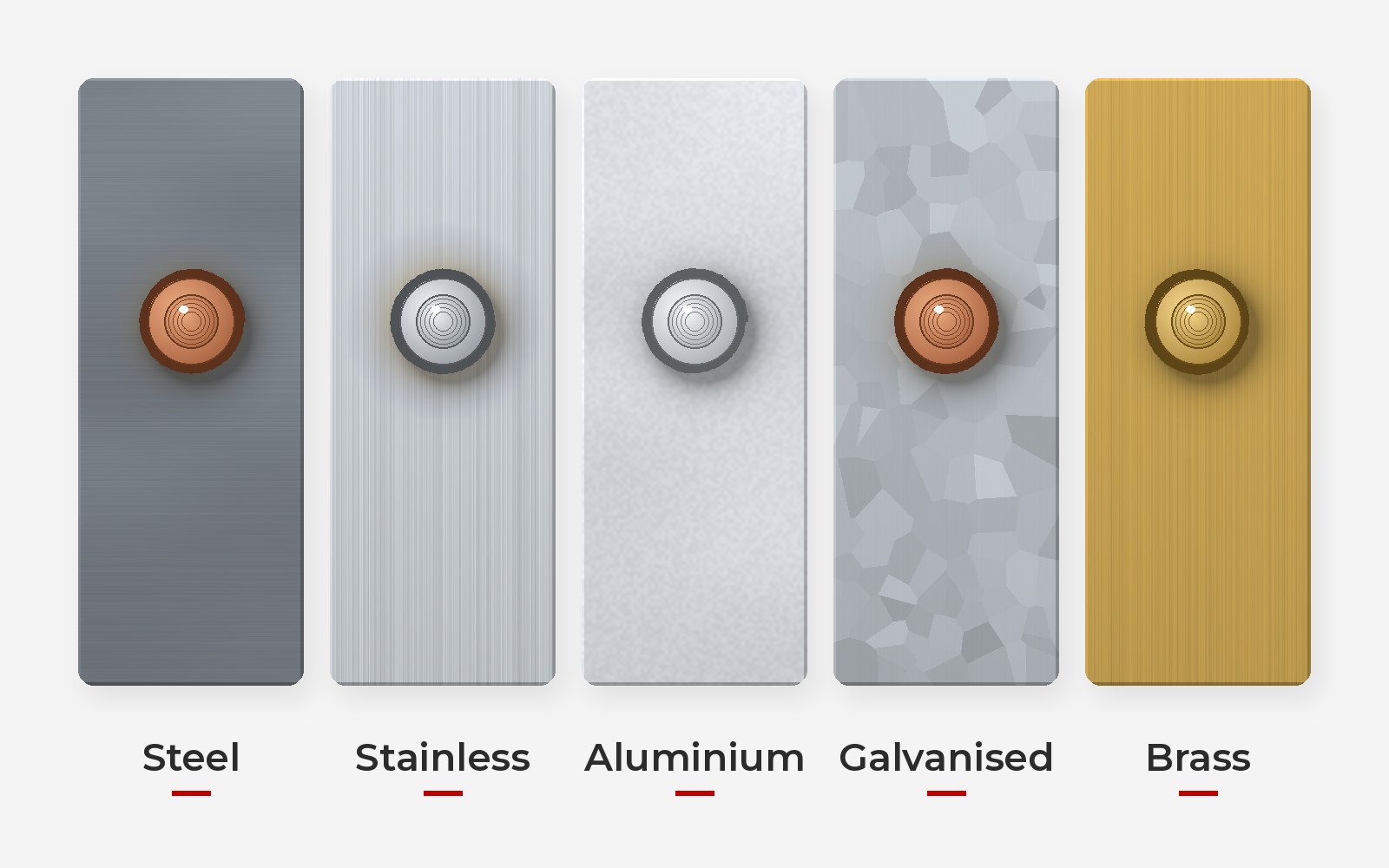
Arnhold supplies weld studs made of steel of property class 4.8, stainless steel A2-50 and A5-50, aluminium (AlMg3) and brass (CuZn37), with other materials available on request. The studs are produced by cold heading and comply with DIN EN ISO 13918. Steel studs usually have a copper coating, and galvanised or nickel-plated surfaces are available on request.
Can studs be welded onto stainless steel?
Yes, stainless steel is very well suited to stud welding, with both tip ignition and drawn arc welding. Stainless steel studs are usually used on stainless steel sheet so that the joint remains corrosion-resistant.
Can aluminium and brass be stud welded?
Yes, both materials are possible, but they require the right process. For aluminium, whether as sheet or as stud, tip ignition using the gap method and drawn arc welding with shielding gas are suitable. Brass studs are mostly welded with tip ignition. Suitable parameters and a clean surface are important, because with aluminium the oxide layer can interfere with the welding process.
Does stud welding work on galvanised sheet?
Yes, studs can be welded onto galvanised sheet, but the result depends on the thickness of the zinc layer. Thin zinc layers are usually no problem with tip ignition, while with thick layers it may be necessary to remove the zinc at the weld spot. Evaporating zinc produces fumes, so the workplace should have fume extraction.
Can you weld onto painted or coated sheet?
As a rule, not directly, because paint and coatings interfere with the current flow and the weld. The weld spot and the spot for the earth clamp should be bare metal. Studs are therefore usually welded before coating. To keep the thread clean during powder coating, Arnhold offers suitable silicone caps.
Can steel and stainless steel be welded together?
Yes, such mixed joints of unalloyed steel and stainless steel, also known as black-and-white joints, are possible in stud welding. However, they need to be considered separately, because their strength can differ from that of a joint between identical materials. If in doubt, the quality is verified by a welding procedure test.
Which materials are unsuitable?
Free-cutting steels with a high sulphur or lead content are not suitable for stud welding, because the weld can crack. Steels with a high carbon content are also critical. If in doubt, a test weld helps, which Arnhold offers by appointment.
Not sure whether your material is suitable?
We will be happy to advise you personally, by phone on +49 2302 95640-0 or by message.
More topics
What is stud welding and how does it work?
Tip ignition or drawn arc? All processes at a glance.
Load capacity, testing and standards.
Stud welding, riveting or screwing?
