

The short-cycle process is a variant of drawn arc welding for stud diameters from 3 to 10 mm. Thanks to the short welding time and shallow penetration, thinner sheet can also be welded. Here you can find out how the process works and what it is suitable for.
In short
In the short-cycle process, the stud is lifted from the workpiece under a pilot arc, the main arc melts the materials and the stud plunges into the molten pool. The welding time is only 5 to 100 ms at a current of up to 1900 A. The process is easy to automate and can be combined with shielding gas welding.
On this page
What is the short-cycle process suitable for?
Short-cycle welding is used for stud diameters from 3 to 10 mm. Its particular advantage is that, thanks to the short, shallow penetration, thinner sheet can also be welded compared with the other drawn arc processes (1/8 x d). The welding time is 5 to 100 ms at a current of up to 1900 A.
The process stands out for being easy to automate and can also be combined with shielding gas welding.
How does the short-cycle process work?
At the start, the stud rests on the workpiece and is lifted from it. First, a pilot arc is created with low current. After a short "holding time", the main arc is ignited, which really melts the materials.
During the entire welding process, the stud is lifted from the workpiece for the set welding time, which is much shorter in short-cycle welding than in ceramic ferrule welding, and then plunged back into the molten pool of the workpiece. This joins the stud to the workpiece. At the end, the firmly welded stud remains.
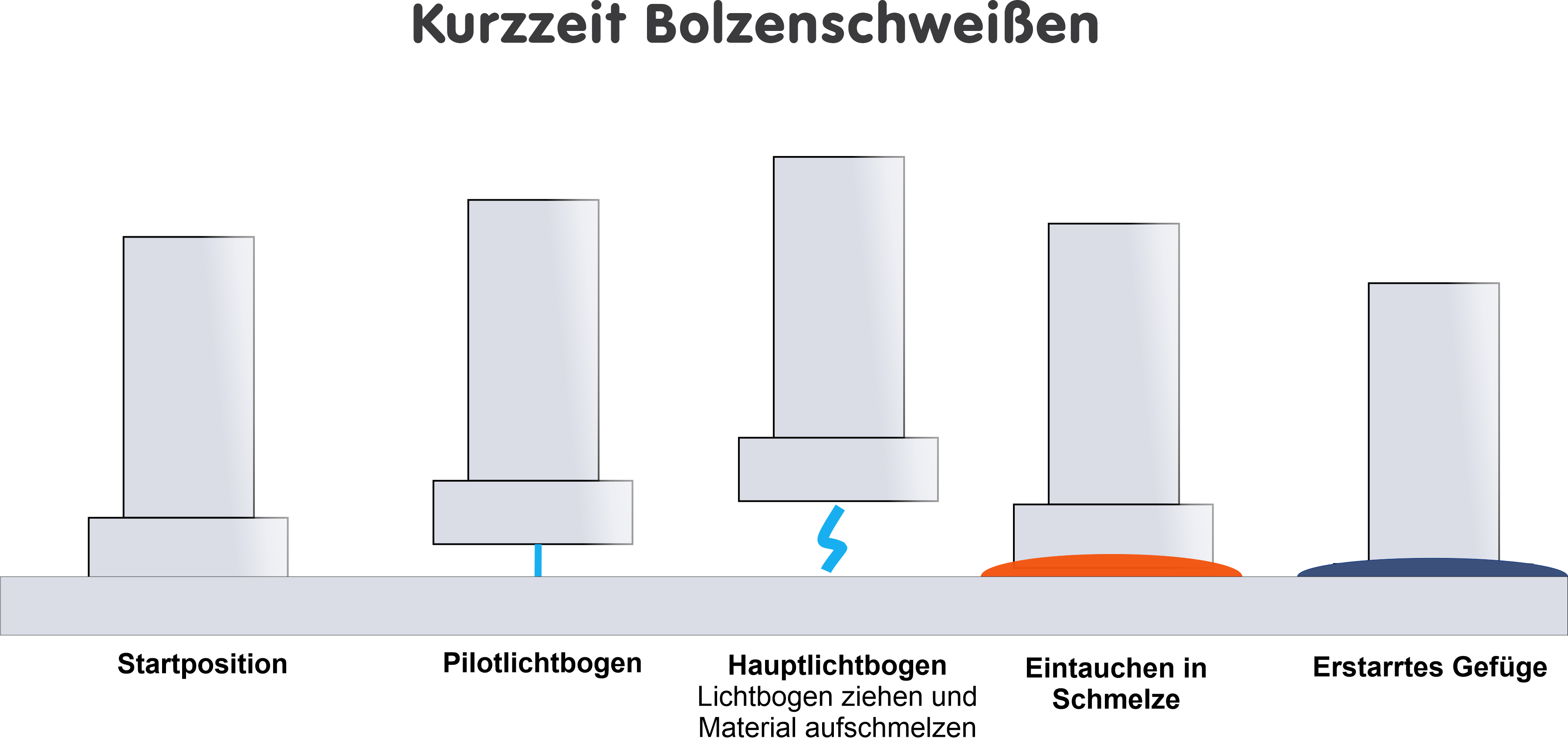
The graphic above shows the sequence in five steps:
- Starting position: The stud rests on the workpiece.
- Pilot arc: The stud is lifted and an arc with low current forms.
- Main arc: The arc is drawn and melts the material.
- Plunging into the molten pool: The stud plunges into the molten pool.
- Solidified structure: The melt solidifies and the joint is complete.
How does it differ from ceramic ferrule and shielding gas?
With a ceramic ferrule, the molten pool is protected by a ferrule fitted over the stud, which is necessary for larger studs and longer welding times. With shielding gas, a gas protects the molten pool from the air. The short-cycle process works without a ceramic ferrule, and shielding gas is only needed in some cases.
What technical data apply?
| Parameter | Value |
|---|---|
| Stud diameter d (mm) | 3-10 |
| Welding time approx. (ms) | 5-100 |
| Current (A) | up to 1900 |
| Min. workpiece thickness | 1/8 d (stud) |
| Surface | Bare metal, galvanised (suitable for poorer surfaces) |
| Ceramic ferrule required | no |
| Shielding gas function required | partly |
You can find all parameters compared with the ceramic ferrule and shielding gas on the drawn arc page. Values may vary depending on unit and application.
What does the short-cycle process look like in practice?
This video shows drawn arc welding with the short-cycle process and with shielding gas:
Would you like to know whether the short-cycle process suits your component?
We will be happy to advise you personally, by phone on +49 2302 95640-0 or by message.
More topics
Scope, variants and key data at a glance.
For large studs and longer welding times.
For very high-quality, visually appealing welds.
Tip ignition or drawn arc? All processes at a glance.
